

How to Calculate and Use Step-Up Basis When Selling Inherited Property
When you inherit property, the IRS automatically resets its cost basis to the fair market value on the date of the original owner’s death. This step-up in basis can save you thousands or even tens of thousands of dollars in capital gains tax when you sell. Instead of paying tax on appreciation that accumulated over the original owner’s entire period of ownership, you only owe capital gains on any increase in value from the inheritance date forward.
Here’s how it works in practice: If your parents bought their home in 1985 for $75,000 and it’s worth $425,000 when you inherit it, your basis becomes $425,000. Sell it a year later for $435,000, and you’re only taxed on $10,000 in gains, not the $360,000 your parents would have owed. That difference translates to real money staying in your pocket.
This tax benefit applies to most inherited property, including primary residences, vacation homes, and investment properties. The mechanics are straightforward, but getting them right requires proper documentation and understanding which valuation date to use, especially in community property states or when dealing with trusts.
The step-up basis rules changed significantly over the years, and there are specific situations where the benefit doesn’t apply or requires careful planning. If you’re managing an inherited property right now, knowing how to calculate your stepped-up basis correctly and what records the IRS expects you to keep will help you make informed decisions about timing the sale and maximizing your tax advantage.
What Is Step-Up Basis and Why It Matters for Inherited Property

Step-up basis is a tax provision that resets your cost basis in inherited property to its fair market value on the date the previous owner passed away. Instead of inheriting the original purchase price the deceased paid decades ago, you get a fresh starting point at current market value. This matters enormously when you sell because capital gains taxes are calculated on the difference between your sale price and your cost basis, the higher your basis, the lower your taxable gain.
Here’s how it works in practice. Suppose your parents bought their home in 1985 for $80,000, and it’s worth $450,000 when they pass away in 2026. Without step-up basis, your cost basis would be their original $80,000 purchase price. If you sold the property for $450,000, you’d face capital gains tax on $370,000 of appreciation. With step-up basis, your new cost basis becomes $450,000, the fair market value at death. Sell it soon after for $450,000, and your taxable gain is zero.
This single provision can save inheritors tens of thousands of dollars in taxes. The larger the gap between original purchase price and current value, the more significant the benefit becomes. That’s why establishing an accurate date-of-death valuation is crucial before you list an inherited property for sale. Getting this number right protects you from unnecessary tax liability and ensures you’re not leaving money on the table when settlement time arrives.
What You’ll Need to Establish Step-Up Basis

Establishing proper documentation for your step-up basis isn’t just good practice, it’s essential protection if the IRS ever questions your reported capital gains. You’ll need specific documents and professional support to calculate the basis correctly and defend it years later when you file your tax return after selling.
Start gathering these core documents as soon as possible after inheriting the property:
- Death certificate showing the official date of death, which establishes when the basis resets
- Professional property appraisal or formal valuation completed as close to the date of death as possible
- Property deed or title documents proving ownership transfer to you as the heir
- Estate tax return (Form 706) if the estate was large enough to require filing
- Original purchase documents from when the deceased bought the property, showing their cost basis
- Contact information for a qualified CPA or tax advisor experienced with inherited property
The most critical item on this list is the professional appraisal. If the estate didn’t commission one within a reasonable window of the death date, you’ll need to obtain a retrospective appraisal, where a licensed appraiser determines what the property would have sold for on that specific past date. This costs more than a standard appraisal (typically $400, $800 depending on your market) because it requires additional comparable sales research for that historical period.
You’ll also want copies of any trust documents if the property was held in trust, probate court records if the estate went through probate, and property tax assessments from the year of death. These supporting documents help corroborate your appraisal value if questions arise. Don’t rely on online estimates or tax assessor values alone, the IRS expects a legitimate appraisal method, and assessor values often lag behind actual market values by months or years.
Important Warnings and Special Circumstances
Step-up basis comes with important exceptions and limitations that can significantly affect your tax outcome. Understanding these circumstances before you sell helps you avoid costly surprises and ensures you’re applying the rules correctly.
Community Property vs. Separate Property
If the property was located in a community property state (Arizona, California, Idaho, Louisiana, Nevada, New Mexico, Texas, Washington, or Wisconsin), you may receive a full step-up basis on the entire property, even if you only owned half. In community property, both halves of jointly-held property generally get stepped up when one spouse dies. By contrast, in common law states, only the deceased’s share receives the step-up if the property was held as joint tenants or tenants in common.
Property Transferred Before Death
Gifts made while the original owner was alive don’t qualify for step-up basis. If your parents transferred the property to you before death (perhaps to avoid probate), you receive their original cost basis through a “carryover basis” instead. This can result in much higher capital gains taxes when you sell. Property transferred during divorce proceedings similarly follows different basis rules, which you can explore further when selling during divorce.
Joint Ownership Complications
How the property was titled matters enormously. Joint tenancy with rights of survivorship, tenancy by the entirety, and tenancy in common each have different step-up rules. If you inherited as a surviving joint tenant, typically only the deceased owner’s percentage receives a step-up. Sole ownership by the decedent provides the cleanest step-up scenario.
Always consult a tax professional if your situation involves joint ownership, community property, or property received before death. These exceptions can dramatically change your tax liability.
Step-by-Step: How to Calculate Your Step-Up Basis
Calculating your step-up basis requires a methodical approach to ensure accuracy and proper documentation for tax purposes. The process is straightforward if you follow these steps in order and gather the right information along the way.
- Determine the exact date of death. This is your valuation date for step-up basis purposes. The executor or estate administrator should have this documented in estate records. In some cases, estates can elect an alternate valuation date six months after death, but this requires specific IRS forms and circumstances.
- Obtain a professional appraisal or use the estate’s valuation. Hire a licensed real estate appraiser to determine the property’s fair market value as of the date of death. If the estate already had the property appraised for probate purposes, you can typically use that same valuation. The appraisal should be thorough and defensible in case of an IRS audit.
- Check the ownership structure. Review how the deceased held title to the property. If it was community property, both halves typically receive a step-up in basis. For joint tenancy with rights of survivorship, only the deceased’s portion gets stepped up. Sole ownership properties receive a full step-up for the entire property value.
- Calculate your percentage if there are multiple heirs. If you’re one of several beneficiaries, determine your ownership share from the will or trust documents. Your stepped-up basis equals the total property value at death multiplied by your inheritance percentage. For example, if the property was valued at $500,000 and you inherited a one-third share, your stepped-up basis is $166,667.
- Document the stepped-up basis in writing. Create a clear record that includes the date of death, the appraisal report, your ownership percentage, and the calculated basis amount. Keep copies of the death certificate, appraisal, estate documents, and any probate records with these calculations.
- Consult with a tax professional to verify your calculation. A CPA or tax attorney who specializes in estate and real estate taxation can review your work, confirm you’ve applied the rules correctly for your specific situation, and advise on any state-specific considerations that might affect your basis.
Once you complete these steps, you’ll have a defensible stepped-up basis that serves as your new cost basis for the property. This becomes the foundation for calculating any capital gains when you eventually sell. Keep all documentation organized and accessible, as the IRS may request proof of your basis calculation years after the inheritance if you’re audited following a sale.
Applying Step-Up Basis When You Sell the Inherited Property
When you’re ready to sell your inherited property, the step-up basis becomes your most powerful tax-saving tool. The calculation is straightforward: take your sale price, subtract your stepped-up basis (the fair market value at the date of death), then subtract your selling costs to determine your taxable capital gain.
Here’s how it works in practice. Let’s say you inherited a home valued at $400,000 when your parent passed away in January 2026. You decide to sell it nine months later for $415,000. Your selling costs, including real estate commissions, title fees, and closing expenses, total $28,000. Your capital gains calculation looks like this: $415,000 (sale price) minus $400,000 (stepped-up basis) minus $28,000 (selling costs) equals $−13,000. That’s actually a capital loss, meaning you owe zero capital gains tax and may be able to deduct the loss against other capital gains.
Now consider a different scenario where you hold the property longer. You inherit that same $400,000 home, but you wait three years before selling. During that time, the market heats up and you sell for $480,000 with $32,000 in selling costs. Your calculation: $480,000 minus $400,000 minus $32,000 equals $48,000 in taxable capital gains. Without the step-up basis, you’d have calculated gains from your parent’s original purchase price, potentially decades ago, which could have resulted in a six-figure tax bill instead.
Your selling costs are fully deductible and include more than just the agent commission. Count your curb appeal strategieshome staging costs professional photography, inspection repairs you made to close the sale, title insurance, escrow fees, and any transfer taxes. Keep detailed receipts for everything, these expenses directly reduce your taxable gain.
The stepped-up basis resets your starting point to the inheritance date, effectively erasing all the appreciation that occurred during the original owner’s lifetime. That’s the benefit, and it applies whether you sell immediately or years later.
Verifying Your Calculation and Next Steps
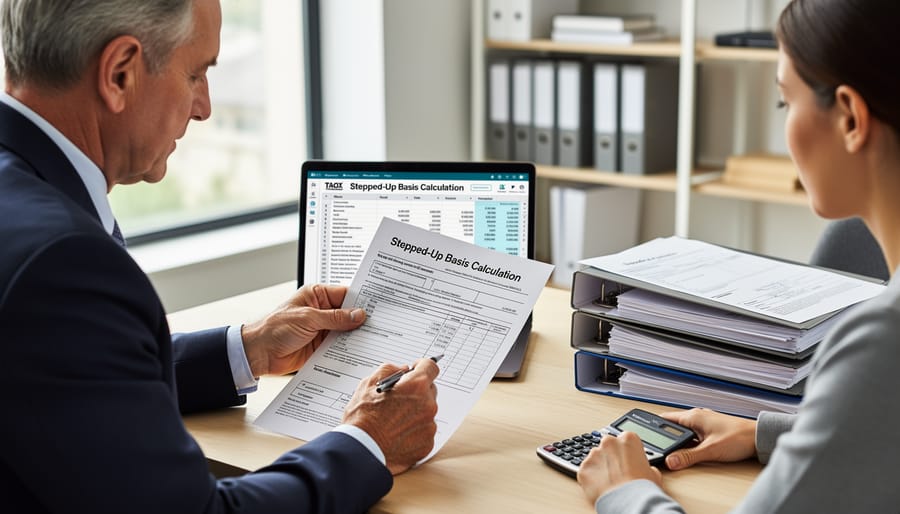
Once you’ve calculated your step-up basis, proper verification prevents costly errors and protects you during an IRS audit. Start by cross-checking your date-of-death valuation against comparable sales from that specific time period. Real estate values can shift significantly even within a few months, so precision matters.
Schedule a consultation with a CPA or tax attorney who specializes in estate and capital gains taxes. Bring your complete documentation package: the professional appraisal, estate inventory, property records, and your calculation worksheet. They’ll verify your math, confirm you’ve applied the correct basis rules for your ownership situation, and identify any selling costs you can legitimately add to reduce your taxable gain.
Keep meticulous records organized in both physical and digital formats. The IRS can request documentation for up to three years after you file, or six years if they suspect significant underreporting. Your permanent file should include the original appraisal, probate documents establishing the date of death, closing statements from the sale, receipts for improvements made between inheritance and sale, and all correspondence with tax professionals.
When you sell, you’ll report the transaction on Schedule D (Capital Gains and Losses) and Form 8949 (Sales and Other Dispositions of Capital Assets) with your tax return for that year. Your stepped-up basis becomes the cost basis on these forms.
Before listing the property, consider how presentation affects your net proceeds. Professional preparation, including high-quality staging pictures, can significantly increase your sale price, maximizing the benefit of your favorable tax position. Work with a real estate professional experienced in inherited property sales who understands the timeline pressures executors face and can coordinate with your estate attorney to ensure a smooth closing.
What You Need
Before you begin calculating your step-up basis, gather these essential items to streamline the process and ensure accurate documentation:
Required Documents:
– Death certificate (certified copy)
– Property deed showing ownership transfer
– Estate documents (will, trust documents, or probate court orders)
– Property tax assessments from the year of death
– Any existing appraisals or valuations
Professional Services:
– Qualified real estate appraiser licensed in your state
– Estate attorney or probate lawyer
– Tax professional or CPA experienced with inherited property
Financial Records:
– Mortgage statements if debt existed at death
– Home improvement receipts from the deceased’s ownership
– Property insurance records
– HOA documents if applicable
For Sale Preparation:
– Recent comparable sales data in the neighborhood
– Current property condition assessment
– List of needed repairs or updates
– If you’re planning to sell soon, consider staging tips to maximize your property’s value
Having these materials organized upfront will save time when working with professionals and help ensure your step-up basis calculation is properly documented for tax purposes.
Common Questions About Step-Up Basis and Inherited Property
Do all heirs get the step-up basis, or just some?
All heirs who inherit a property share the stepped-up basis proportionally to their ownership percentage. If three siblings each inherit a third of the property, each gets a third of the stepped-up basis when calculating their individual capital gains upon sale.
What if no professional appraisal was done at the time of death?
You can still establish fair market value using alternative documentation like county tax assessments from that period, comparable sales data from the date of death, or a retrospective appraisal that determines what the property would have been worth at that specific date. The IRS accepts reasonable valuation methods as long as they’re properly documented.
How does step-up basis work if the inherited property was used as a rental?
The step-up basis applies to rental properties the same way it does to primary residences, the basis resets to fair market value at death. However, if you continue operating it as a rental after inheriting, you’ll calculate depreciation from the new stepped-up basis, and you won’t owe recapture tax on depreciation the original owner claimed.
Can I still use step-up basis if I live in the inherited home before selling?
Yes, you retain the step-up basis regardless of whether you sell immediately or live in the property first. Living in the home for two of the five years before sale may also qualify you for the primary residence capital gains exclusion of up to $250,000 (or $500,000 for married couples), which works in addition to the step-up basis benefit.
Does step-up basis apply if the property was in a trust?
Properties held in revocable living trusts typically receive full step-up basis at the grantor’s death, just like probate assets. Irrevocable trusts depend on the specific terms and when the property was transferred, some may not qualify for step-up basis at all.
What happens if I inherited property from someone who died years ago but I’m just now selling?
The step-up basis is locked in at the date of the original owner’s death, not when you decide to sell. You’ll still use the fair market value from that earlier date as your basis, which is why establishing and documenting that value at the time of inheritance is so important, even if you don’t plan to sell right away.
These questions cover the scenarios that trip up most people dealing with inherited property. The timing issue catches many heirs off guard, they assume the basis somehow updates over time or that delaying the sale changes the calculation. It doesn’t. Your cost basis is permanently set at the date of death, which means a property inherited in 2020 and sold in 2026 still uses the 2020 valuation.
The rental property question deserves special attention because it combines two tax concepts. You get the step-up benefit and a fresh depreciation schedule, which is about as close to a tax windfall as the code allows. If the original owner claimed $100,000 in depreciation over 20 years, that’s forgiven entirely. You start with the stepped-up value and depreciate from there if you keep renting it out.
Living in the home before selling opens a path to stack two major tax benefits. The step-up basis already reduces or eliminates the gain from the original purchase to death. The primary residence exclusion can then shelter up to $250,000 of any remaining gain from death to your eventual sale. It requires planning and a two-year commitment, but it’s worth considering if you have substantial appreciation post-inheritance.
Understanding step-up basis can mean the difference between a significant tax bill and keeping thousands of dollars from your inherited property sale. This tax benefit exists specifically to help heirs like you avoid being penalized for appreciation that occurred during the previous owner’s lifetime, appreciation you never actually experienced as gains.
While the concept itself is straightforward, getting the details right matters enormously. The IRS expects proper documentation, accurate valuations, and correctly calculated basis adjustments. Small errors in establishing your stepped-up basis can lead to overpaying taxes or, worse, facing penalties during an audit.
That’s why working with experienced professionals, a qualified appraiser, a CPA familiar with estate taxation, and potentially an estate attorney, isn’t optional. It’s essential. These experts ensure you’re capturing every dollar of tax benefit you’re entitled to while staying fully compliant with tax requirements.
If you’re ready to sell your inherited property and want guidance through the entire process, Your Home Tour specializes in helping homeowners navigate inherited property sales. We understand the unique challenges you’re facing and can connect you with the right professionals to maximize your financial outcome while minimizing stress and uncertainty.